|
Reprinted
with permission from the Victor Valley Daily Press.
Little Earth People
Story
and photos by SUSAN D. LAWSON / Staff Writer
Pam and Phil Wallberg
are married to the mob — a mob of meerkats, that is.
|
Suri, a male
meerkat, looks for a mealworm handout from Pam Bennett-Wallberg, founder
of Fellow Earthings' Wildlife Center. |
The
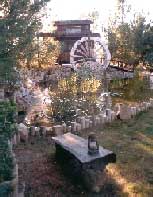
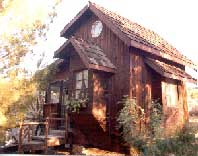
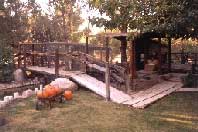
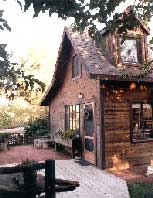
Wallbergs care for their gang of seven at their rustic Morongo Valley
home, the Fellow Earthlings' Wildlife Center, which is the only privately
licensed meerkat facility in the Western Hemisphere.
"All
of our meerkats are orphans, sick, old, injured or they've run out of
room in a zoo," said Pam Bennett-Wallberg, who has taken care of meerkats for
the past 20 years.
Her
first experience with the cheeky creatures was as the Director of Wildlife
Programs at the Living Desert wildlife and botanical park in Palm Desert.
"One
day they had a litter of meerkats born and one was not thriving," Pam
said. "They asked if I would take it home (for rehabilitation), so I
did."
In less
than two weeks, the meerkat started to thrive, so the Wallbergs decided
to name the baby Kalahari — after the African desert where the animals
originate.
"(Pam)
has the magic touch," Phil Wallberg added.
But
when it came time to return Kalahari to the Living Desert's meerkat
home, the animal wasn't so cooperative.
"It
just wasn't successful," Pam said. "She was too used to people. The
other meerkats shunned her, so she would just sit off by herself."
The
Wallbergs asked the curator of the Living Desert if they could remain
Kalahari's keepers. But because meerkats are one of the most strictly
regulated animals in the world, the Wallbergs faced a wall of red tape.
|
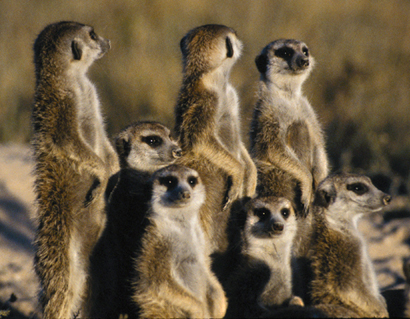
A meerkat
stands on its hind legs to take advantage of the last warm rays
of afternoon sun. The black fur around their eyes act as sunglasses. |
"Everyone was saying
'no' to us, and that we'd never qualify for the proper permits and licenses,"
Pam said.
For
two years, the Wallbergs plowed through paperwork, constructing meerkat-approved
enclosures and undergoing stringent inspections to make their dream
come true.
At times
ready to throw in the towel, Pam said it was husband Phil, a retired
Marine fighter pilot, who kept her going.
"He
told me 'no guts, no glory,' " she said. "It sure took a lot to get
where we're at."
Finally
receiving the proper accreditation in 1989, the Wallbergs now must maintain
special permits from California Fish and Wildlife, the U.S.D.A. and
Fish and Wildlife Service.
The
Wallbergs hope to care for more meerkats, "but we need $4,000 to build
another enclosure first," Pam said.
As a
nonprofit facility, the Wallbergs rely on donations to care for the
meerkats. As an incentive, they offer a meerkat adoption program.
"This
doesn't mean we send (meerkats) home with you," laughed Pam. "Although
meerkats are adorable and captivating, they do not make good pets."
Instead,
the $100 adoption donation allows the adoptive parent and their
guests to feed and interact with the endearing creatures.
"Unlike
a zoo, you can get inside (the enclosures)," Pam said. "The meerkats
love it and the people love it. It's a win-win situation."
Adoptions and donations also defray feeding costs. Wallberg said
it takes $100 a week to keep up with the animal's steady diet of mealworms,
crickets, wax worms and superworms. Until eaten, the bugs take up residence
in Tupperware-type food containers in and on top of the kitchen refrigerator.
|
Meerkats
eat a variety of insects, including these mealworms. |
"And we often have
barrels of crickets in the living room," Pam said. "They make quite a
noise, but we've gotten use to it and don't even hear them anymore."
Native
to dry regions of the Kalahari Desert in Africa, meerkats (suricata
suricatta), are a member of the mongoose family. These small, but voracious
omnivores dine on roots, insects, snakes, lizards and the occasional
mouse or bird. Their long, curved claws are ideal for digging a maze
of underground tunnels or looking for food.
Family
groups are called mobs or gangs, and can include more than a dozen members.
In the wild they are fiercely territorial, and an entire family will
rise to fight off intruders.
A meerkat
can live 12 to 14 years. They spend much of their time foraging for
food, grooming, playing or sunbathing. They often stand on their hind
legs to look for danger or soak up warmth of the sun.
"We
call them 'the solar panels of the animal world'," Pam said.
|
Phil Wallberg,
center, sits with adoptive parent Marilyn Forrest, left, and her
guest Jean Heeringa, as they feed the meerkats. Adoptive parents
come from around the world, including Turkey, Spain, Australia and
England. |
The mannerisms
and playfulness of a meerkat is often compared to our own, earning them
the German name erdm nnchen, which means "little Earth people."
The
meerkats at Fellow Earthlings love visitors, not only because they are
treated to their favorite foods, but it is also keeps their minds stimulated.
"It's
an enrichment for them to meet new people," Pam said. "We also change
their toys daily — (meerkats) are so intelligent."
The
Wallberg's meerkats have also become celebrities. Pam was a consultant
to Disney during the animation of the "Lion King" character, Timon,
who was modeled after Kalahari.
"(Disney) wanted to know what the Top 10 personalities of a meerkat
was, or they'd call and ask 'does a meerkat do this?', and I'd tell
them 'yes' or 'no,' " Pam said.
And
how well did Disney do with their animated meerkat?
"We
were soooo pleased," Pam said. "The personality was right on — sassy,
big attitude."
|
Meerkat soaks
up warmth of the sun. |
National Geographic
has visited the facility a couple of times — once to film their 2002 television
documentary "Meerkat Madness," and just recently for its September 2002
magazine cover story.
Animal
Planet recently filmed part of their upcoming May 12 documentary, "The
Power of Play," at the center, which will compare animal play to how
humans play.
Like
caring for children, taking care of the meerkats is a 24/7 endeavor,
but the Wallbergs wouldn't trade places with anyone. Despite the high
demands of the meerkats, the Wallbergs are also raising a Labrador puppy
as a seeing-eye dog for Guide Dogs of the Desert.
"People
have been good to us and we want give a little back to the community,"
Pam said. "It's not that we have to do this. It's the fact we get up
and get to do this. (Meerkats) have brought so much to our lives."
THE
MEERKAT MOTTO
Respect
the elders, teach the young, cooperate with the family, play when you
can, work when you should, rest in between, share your affection, voice
your feelings, leave your mark.
—
The Fellow Earthlings' Wildlife Center
- What: Fellow Earthlings' Wildlife Center, a nonprofit facility
dedicated to the care of meerkats
- Where: 11427 West Drive, Morongo Valley, California, 92256.
Mailing address is P.O. Box 1319.
- Information: (760) 363-1344 or e-mail at info@FellowEarthlings.org
- On
the Web: http://www.FellowEarthlings.org/
- Adoptions: $100 tax deductible donations. Adoption privileges
(by appointment Friday through Sunday only) includes touring
the center, hand-feeding of the meerkats, personalized adoption
certificate, framed color photo of your meerkat, meerkat fact
sheet.
|